





International Anti-Corruption Excellence Award Celebrates Global Integrity Leaders at Its Ninth Edition in Doha
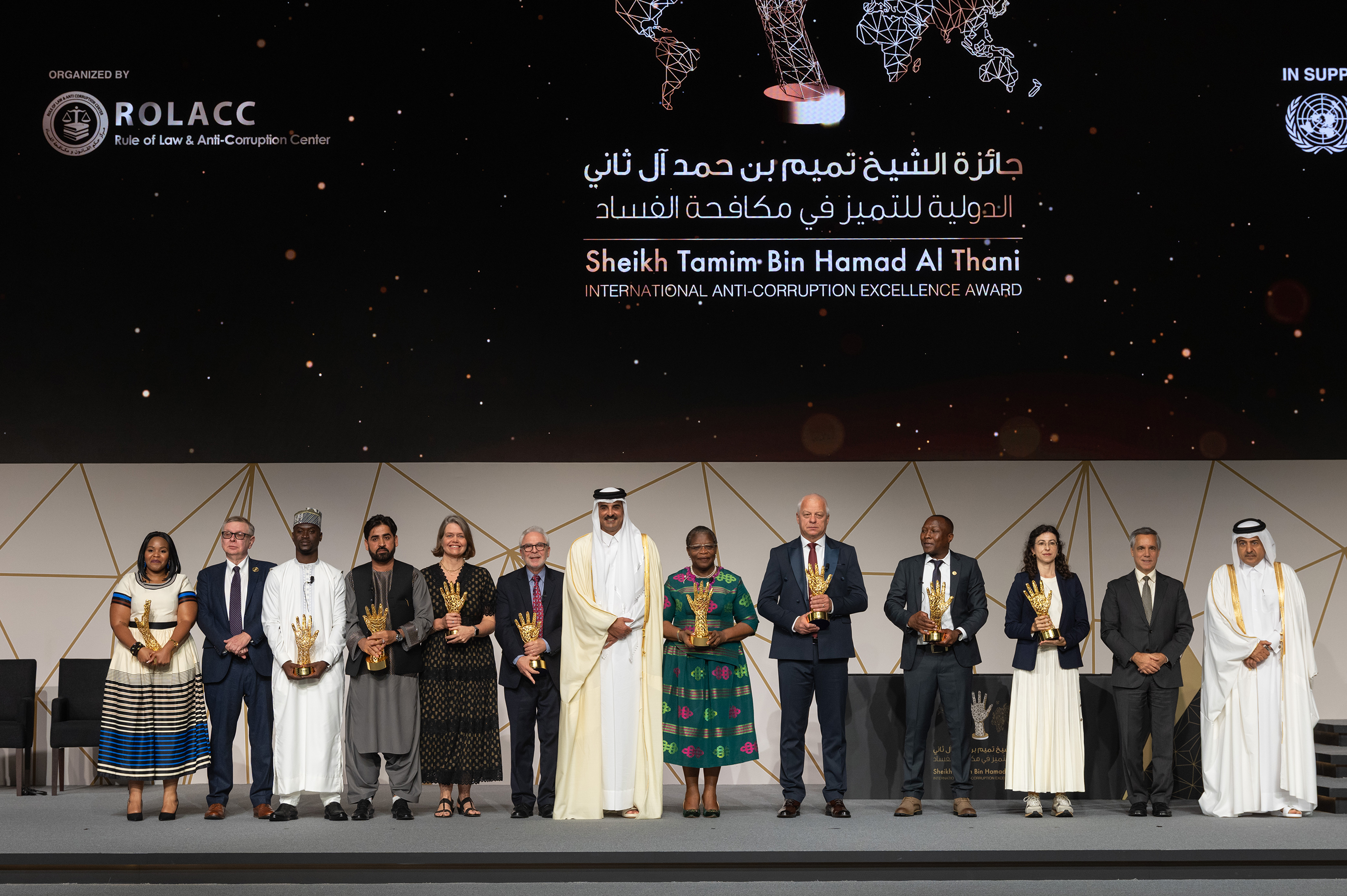
The Sheikh Tamim Bin Hamad Al Thani International Anti-Corruption Excellence Award marked a new milestone today as distinguished guests, international partners, and integrity advocates gathered at Katara Hall in Doha to celebrate the outstanding work of this year’s laureates. The 2025 edition marks the Award’s return to Doha, following its last ceremony in the city in 2022, reaffirming Qatar’s ongoing commitment to advancing global integrity efforts.
Held under the patronage of His Highness Sheikh Tamim Bin Hamad Al Thani, Amir of the State of Qatar, and in support of the United Nations Office on Drugs and Crime (UNODC), the ceremony honored individuals making significant and lasting contributions to transparency, accountability, and the global fight against corruption.
Since its launch in Vienna in 2016, the Award has become one of the world’s most respected recognitions of excellence in anti-corruption work. Over nine editions hosted in cities including Vienna, Geneva, Kuala Lumpur, Kigali, Tunis, Doha, Tashkent, and San José, the Award has celebrated 68 outstanding recipients whose impact spans continents and sectors.
This year’s ceremony brought together more than 1500 participants, including senior United Nations officials, ministers, ambassadors, government leaders, anti-corruption experts, and members of the international and diplomatic community.
Each of the 2025 laureates received the Award’s signature trophy and certificate, symbolizing global recognition of their leadership, innovation, and unwavering commitment to advancing integrity.
After the conclusion of the ceremony, a dedicated panel session brought together the 2025 Award recipients. The session provided a platform to discuss emerging integrity challenges and highlighted innovative solutions proposed by the laureates.
Hosted once again, the 2025 edition reaffirmed Qatar’s steadfast commitment to championing international cooperation and strengthening global frameworks that promote transparency and good governance.
The International Anti-Corruption Excellence Award recognizes recipients across four categories:
- Lifetime or Outstanding Achievement
- Academic Research and Education
- Youth Creativity and Engagement
- Innovation or Investigative Journalism
Honored during the 2025 ceremony were:
Mr. Drago Kos from Slovenia - Lifetime or Outstanding Achievement
Mr. Drago is a leading global figure in anti-corruption with more than 30 years of impact. He chaired the OECD Working Group on Bribery from 2014 to 2022, guiding major reforms and contributing to the 2021 Anti-Bribery Recommendation. Previously, as Chair of GRECO at the Council of Europe, he helped advance international standards for combatting corruption.
In Slovenia, he served as the first Chairman of the Commission for the Prevention of Corruption, establishing it as a global model and authoring the country’s anti-corruption strategy and landmark 2010 Integrity and Prevention of Corruption Act.
He has also co-drafted key global standards, including the 2025 Corruption Prevention Handbook for Forensic Drug Laboratories.
Dr. Obiageli Ezekwesili from Nigeria – Lifetime or Outstanding Achievement
Dr. Obiageli Ezekwesili is a leading global advocate for transparency and good governance with over 30 years of impact. She co-founded Transparency International and helped shape the Corruption Perceptions Index.
In Nigeria, she led major anti-corruption reforms, negotiated the Nigeria–G8 Anti-Corruption Compact, and founded TUGAR to strengthen national integrity systems. She also advanced transparency in public procurement and the oil and gas sector through EITI.
As a former Minister of Education, she introduced key reforms to curb exam fraud and improve accountability. Her influence extended across Africa through her role as World Bank Vice President for the region, promoting governance and institutional reforms continent-wide.
Prof. Nikos Passas from Greece - Academic Research and Education
Professor Nikos Passas is a leading global scholar whose work on crime control and integrity for more than 35 years has shaped the field and the global anti-corruption architecture.
He has authored over 300 publications in 15 languages; among his most impactful scholarly contributions are the Legislative Guides for the United Nations Convention against Corruption and the United Nations Convention against Transnational Organized Crime.
He developed key global tools such as the legal database for the UN TRACK platform and the official UNCAC Implementation Review Checklist used by over 190 States Parties.
As an educator, Professor Passas has trained practitioners globally, taught at leading universities, and supported major institutions including the IMF, World Bank, UNODC, and the European Commission. His expertise has shaped academic programs and international training initiatives, and his testimony has informed major cases on corruption and financial crime.
Dr. Marianne Camerer from South Africa - Academic Research and Education
Dr. Marianne Camerer is a leading expert in integrity and governance with nearly three decades of impact across Africa and beyond. Her early work at the Institute for Security Studies shaped foundational thinking on anti-corruption agencies and whistleblowing, influencing national policies such as South Africa’s National Anti-Corruption Strategy.
As co-founder of Global Integrity, she introduced innovative, evidence-based tools that helped governments, civil society, and researchers assess corruption risks and strengthen accountability systems. She has also worked with teams from the Nelson Mandela School of Public Governance at the University of Cape Town to strengthen leadership capacity on the continent.
Dr. Camerer’s expertise has supported key UN initiatives on public service ethics, national anti-corruption strategies, and UNODC programme evaluations.
Ms. Gloria Pallares Vinyoles from Spain - Innovation / Investigative Journalism
Ms. Gloria Pallares Vinyolles is an investigative journalist with over a decade of impactful work at the intersection of environmental integrity, Indigenous rights, and anti-corruption.
Since 2021, supported by the Pulitzer Center and the International Center for Journalists, she has led major cross-continental investigations exposing corruption in forest and carbon governance across Central Africa and Latin America.
Her reporting uncovered a fraudulent scheme targeting over 9.5 million hectares of Indigenous forest land in Peru, Bolivia, and Panama, empowering the Matsés Nation to reject it and prompting international action.
In the Congo Basin, she revealed illegal logging, mining, and corrupt carbon deals spanning areas twice the size of Rwanda, contributing to EU-supported investigations and the cancellation of corrupt contracts.
Mr. Tatenda Chitagu from Zimbabwe - Innovation / Investigative Journalism
Mr. Tatenda Chitagu is a courageous investigative journalist whose work blends integrity, accountability, and fearless reporting. He has contributed chapters to internationally published books, including “Anti-Social Media? The Impact of Journalism on Society” and “Investigative Journalism Today: Speaking Truth to Power.” His commitment to rigorous research earned him a six-month fellowship at Oxford University to study the relationship between media and political power in Zimbabwe.
His investigation “On the Trail of Lithium Smugglers in Southern Africa” exposed illegal mineral smuggling networks involving border officials, security agents, and politically connected elites. He has also revealed the misuse of COVID-19 funds and public resources, sparking public debate and encouraging stronger oversight.
Through his bold reporting, Mr. Chitagu continues to advance transparency, protect the public interest, and empower communities across Zimbabwe and Southern Africa.
Ms. Andiswa Matikinca from South Africa - Innovation / Investigative Journalism
Ms. Andiswa Matikinca is an environmental investigative journalist who has worked with Oxpeckers Investigative Environmental Journalism since 2018. She co-led the groundbreaking 2025 investigation “On the Trail of Lithium Smugglers in Southern Africa” with journalist Tatenda Chitagu, which uncovered a transnational smuggling network exploiting weak border controls and corrupt officials across Zimbabwe, Mozambique, and South Africa.
Their reporting revealed how illicit traders bypassed Zimbabwe’s 2022 export ban on raw lithium through bribery, forged documents, and local intermediaries, exposing official complicity in undermining lawful mining governance.
Beyond this investigation, Ms. Andiswa has managed the #MineAlert open-data platform, empowering citizens to track mining accountability, and contributed to #WildEye, which helped uncover corruption-enabled wildlife trafficking networks.
Mr. Marr Nyang from The Gambia - Youth Creativity and Engagement
Mr. Marr Nyang is one of Africa’s most influential young anti-corruption advocates, driving transformative reforms in The Gambia. As the founder of Gambia Participates, he has strengthened civic engagement, empowered citizens, and advanced national accountability through evidence-based advocacy and courageous action.
His strategic litigation efforts made history blocking the misuse of 54.4 million dalasis in public funds in 2021, and preventing electoral fraud through decisive court interventions.
He played a key role in the passage of The Gambia’s first Anti-Corruption Act in 2023, uniting Parliament, legal drafters, and civil society to close long-standing governance gaps.
At the national level, his pioneering research and transparency initiatives raised The Gambia’s budget transparency score from 4 to 36 between 2019 and 2023 and culminated in the launch of the first Gambia Corruption Index in 2025.
Mr. Matiullah Wesa from Afghanistan - Youth Creativity and Engagement
Mr. Matiullah Wesa is a courageous education activist and the founder of Pen Path, a civil society organization committed to safeguarding every child’s right to quality education.
His mission began after witnessing the severe obstacles Afghan students face especially girls and children in rural areas and the widespread neglect of the education system. These challenges became even clearer when he uncovered systemic corruption within the Ministry of Education, where funds meant for teachers, textbooks, and essential supplies were being diverted.
He launched nationwide anti-corruption and education campaigns across more than 370 districts, reaching over six million people and raising public awareness of how corruption harms the education system. His efforts prompted the creation of a presidential commission to investigate the sector, where Pen Path played a key role. The commission uncovered “ghost schools,” fraud affecting 1.7 million students, and the misrepresentation of more than 1,400 schools.
End of Press Release
